



















Common Beginner Mistakes in Jump Rope and How to Fix Them

Common Beginner Mistakes in Jump Rope and How to Fix Them
Jump rope is a deceptively simple workout tool that packs a surprising amount of skill into every turn. For many beginners, the first few sessions feel awkward, and progress can stall as soon as the rope catches on a few bad habits. The good news is that most of the common issues are fixable with a few focused cues, deliberate practice, and a clear progression. This guide breaks down the most frequent beginner mistakes, explains why they derail your progress, and offers practical fixes that work for most body types, ages, and skill levels. Whether you're aiming for a fast-paced double under routine or just want a reliable warm-up, these adjustments will set you on a smoother path.
Before we dive in, a quick note on equipment and setup. A properly sized rope is essential. Rope length that’s too long or too short makes even the simplest jump feel awkward and can lead to bad technique as you compensate. The rope type matters too: beginners often start with a beaded rope or a light, speed-style rope. Beaded ropes are forgiving on the ground and good for building rhythm, while speed ropes are great for speed and coordination once you master the basics. Shoes with a little cushion and a non-slip sole help you stay stable on the floor, and a flat surface like wood, vinyl, or a gym mat is ideal. Finally, start with a slow, steady pace to establish timing before you push for speed or fancy footwork. Now, let’s identify the common missteps and how to fix them.
1. Rope Length: Too Long or Too Short
One of the very first things beginner jumpers notice is that the rope feels “wrong” from the moment they swing it. The rope tangles, catches on the floor, or whips you in the shins. More often than not, the culprit is rope length. If the rope is too long, you’ll be forced to overextend your arms and wrists to generate enough clearance, which leads to dragging the rope or tripping on every other turn. If it’s too short, the rope will whip into your shins and calves, and you’ll feel cramped, with little room to move.
How to check and fix rope length:
- Stand with both feet together in the middle of the rope. Hold the handles up so they align roughly with your armpits or sternum. If the handles barely reach your armpits, the rope is about right for many adults; if they reach the shoulder or go past it, the rope is likely too long. If the handles touch your chest when you stand on the rope, it’s too short.
- Alternative quick test: hold the rope by the handles and let it hang down to your feet. The length should reach roughly your armpits or a touch lower.
- Adjust in small increments. Many ropes come with adjustable cords or you can tie a knot at the appropriate length on a rope with a fixed length. Recheck with the same standing test after adjusting.
- Rope type matters for feel. A beaded rope can feel longer because of air resistance, while a thinner cable rope might feel shorter but still be appropriate. Use a rope that moves predictably at the height you want to jump.
Fix plan and practice ideas:
- For the next two sessions, work with a rope length you estimate to be around the middle of your height range (not too long, not too short). Notice what happens when you swing and land. Do you trip easily? Do you feel the rope hitting your shins less often after a quick adjustment?
- Practice a controlled two-foot bounce with a steady, slow pace while keeping your wrists relaxed. Don’t rush; let the rope’s arc determine your rhythm.
- If you have access to adjustability, experiment with one inch at a time. When you’ve found a length where the rope clears your feet cleanly and you can land softly, lock it in.
Why this matters: rope length affects timing, wrist action, and ground clearance. A correctly sized rope reduces cramping, improves balance, and makes consistency easier, which lowers the cognitive load for learning more complex moves later.
2. Jumping Too High
Many beginners believe that jumping higher will help the rope clear more easily. In reality, higher jumps create more air time, slow you down, and disrupt rhythm. Excessive jumps also increase impact on the landing, which can lead to fatigue or even shin splints if you push too hard, too soon. The goal is smooth, repeatable contact with the ground and the rope gliding beneath your feet without you having to chase it.
Fixes to bring your jumps down to a sustainable level:
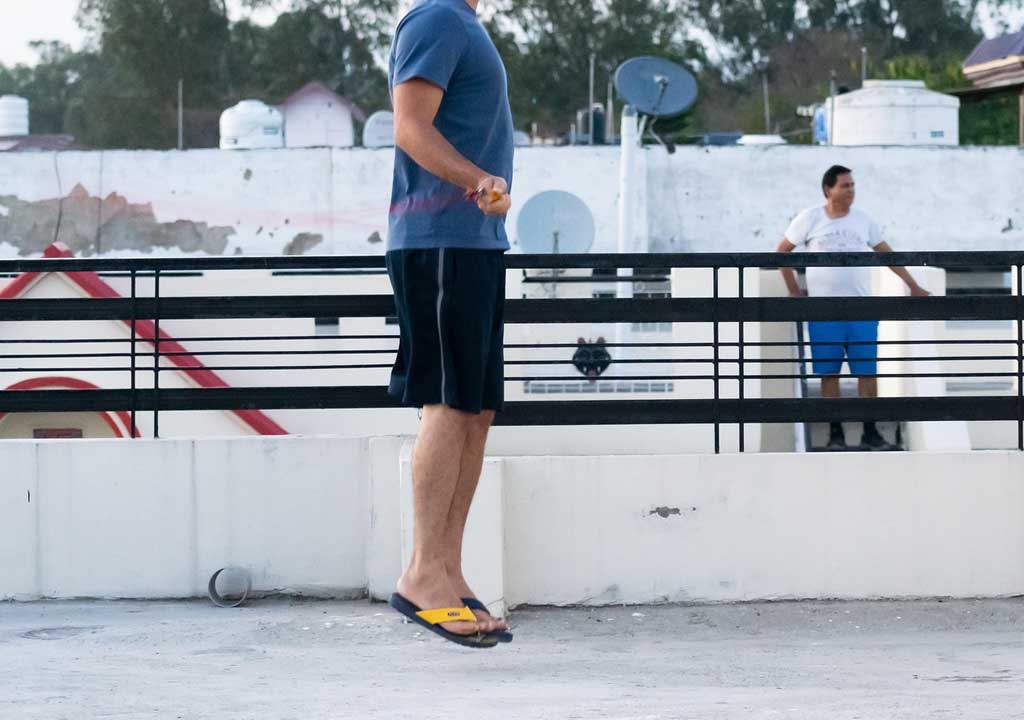
- Keep your jumps very small—aim for about a half-inch to an inch off the ground. If you’re tall, even a centimeter can be enough to clear the rope with a consistent arc.
- Focus on cadence rather than height. Choose a comfortable rhythm (e.g., a quick, even beat) and let momentum and timing take care of clearance.
- Strengthen the landing. Practice a soft, quiet landings with knees slightly bent and hips relaxed to absorb impact. Avoid stomping.
- Use drills that enforce low jumps: single- bounce practice, then two jumps per turn, keeping each landing soft.
Drills to build the right habit:
- Progression drill: two small jumps per turn—every rotation is a tiny hop, not a lunge. Once that feels smooth, add a third jump per turn and revert if you lose tempo.
- Timing check: use a metronome or a simple rhythm in your head (for example, “1-2, 1-2” with each landing). Maintain a constant tempo and avoid speeding up mid-session.
- Video feedback: have a friend film from the side. Look for excessive height and aim to shorten your jump in the next round.
Why this matters: smaller jumps reduce fatigue and improve control, letting you string longer sessions together. With improved timing and a lower impact, you build stamina faster and can progress to more advanced tricks without injuring yourself.
3. Jumping on the Toes Instead of Midfoot
Jumping on the toes or in a tiptoe position is a common reflex for new jumpers who feel the rope’s moment from the ankles. But the most efficient landing for rope skipping is a midfoot or ball-of-foot landing with a slight knee bend. Toe-heavy landings can strain the calves and Achilles, reduce control, and make you feel off-balance. A midfoot approach distributes impact evenly and gives you more leverage for turning the rope with your wrists rather than your legs.
How to fix technique and build new habit:
- Shift weight toward the middle of your foot as you land. Avoid landing on your toes or your heels exclusively.
- Keep a small knee bend on impact to absorb the rope’s rebound. Don’t lock your legs straight; it saps control and makes you bounce in place.
- Balance drills on the floor without the rope: practice standing on one foot, then the other, with a light knee bend and tall spine to build proprioception.
- Teacher cues: imagine your feet absorbing the rope’s bounce as if you’re stepping on a marshmallow—soft, controlled, and quiet.
Practical progressions:
- Start with a few sessions of air-plyometrics (e.g., small jumps in place) to train midfoot landing rhythm. Then add the rope once your landing feels natural.
- Use a slower rope to give yourself time to find the midfoot contact. As control improves, switch to your regular rope.
- Track comfort: if you feel shin or calf strain after a few minutes, pause and reassess your landing and speed. Gradual progression is key.
Why this matters: midfoot landings are more energy-efficient and stable. This foundation is essential for longer routines and for building the conditioning that allows you to explore more advanced skills without sacrificing form.
4. Using Arms Too Much: Relying on Arm Swing Instead of Wrist Turn
A common habit among beginners is to “pump” the rope with elbow and shoulder movements, resulting in wide arms, fatigue, and inconsistent turns. The most efficient method is to initiate the rope turn with quick, compact wrist action while keeping the elbows close to your torso. The wrists do the work, the shoulders stay relaxed, and the rope travels in a tight, predictable arc. When you see entire arms swinging, it’s a sign you’re fighting the rope rather than letting it do its job.
Fixes to cultivate efficient turn mechanics:
- Keep elbows in and wrists moving the rope in a small circle. Think of the rope traveling around your body with the wrist doing the primary rotation.
- Maintain a relaxed grip. Gripping too hard slows you down and creates tension in the forearms that impedes wrist motion.
- Practice with a slower rope to feel the wrist action clearly before you add speed. A slower rope helps you isolate the motion you want to repeat.
- Use a wall drill or a mirror to observe your arm position. The line from shoulder to wrist should stay close to your side, not flaring outward.
Drills and practice ideas:
- Wrist-only turns: with the rope overhead, rotate the rope using only your wrists in slow circles, then gradually apply the same motion to each jump.
- Dry rope practice: turn the rope without jumping for 20 seconds, then add a single-step jump to connect the motion. Increase duration as you gain control.
- Cadence cue: count “one-two” with each turn. A consistent beat helps prevent you from getting ahead of or behind the rope.
Why this matters: efficient wrist turns conserve energy, reduce shoulder fatigue, and improve your ability to maintain a long, steady session. Once wrist technique is solid, you’ll notice a big jump in consistency and the ability to progress to faster RPM and more complex tricks.
5. Poor Posture and Shoulder Tangle
Rounded shoulders, a dropped chest, and tense necks are telltale signs of beginner frustration. Hunched posture makes it harder to breathe effectively, reduces visibility of your rope path, and invites unnecessary tension into the upper body. A healthy jump rope routine depends on a tall, relaxed spine and open chest—like you’re gently pulling your shoulders back to greet the horizon. Good posture helps you stay balanced, keep your timing, and minimize fatigue.
How to fix posture and reduce tension:
- Set an upright stance with a slight micro-bend in the knees. Pelvis neutral; hips stable; spine elongated.
- Relax the shoulders away from the ears. Draw the shoulder blades gently toward the spine without pinching.
- Keep the head level and eyes forward at a comfortable distance. Avoid looking down at your feet; this helps you anticipate the rope’s arc and maintain rhythm.
- Breathing practice: inhale through the nose and exhale through the mouth on a comfortable cadence. Don’t hold your breath during leaps.
Practical drills for better posture:
- Wall drill: stand a few inches from a wall with your back straight and shoulders down. Practice small jumps while maintaining contact with the wall with the mid-back or shoulder blades—this ensures you don’t slouch.
- Mirror checks: perform a short rotation roped loop while watching your posture in a mirror. Stop and adjust every few rotations if you notice rounding or tensing.
- Breath-based pacing: count a single inhale and exhale per jump, ensuring you aren’t holding your breath during the circuit.
Why this matters: posture directly affects breathing, balance, and endurance. A relaxed, upright stance enables longer training blocks with less fatigue and better control, which is essential as you add speed or more complicated footwork.
6. Inconsistent Timing and Rhythm
Rhythm is the backbone of jump rope. The rope’s arc and the feet’s ground contact should align in a predictable cadence. When timing slips, you trip, you overrun your pace, or you start weaving erratically. This can be discouraging and make even short sessions feel chaotic. Inconsistent tempo often stems from a combination of jumping height, arm movement, and a lack of feedback loops to correct mid-session.
Strategies to establish reliable timing:
- Use a metronome or a simple counting method. Start with a comfortable tempo like 60-72 beats per minute, then adjust as your endurance and control improve.
- Practice sub-routines that isolate rhythm: two-foot jump on every beat, alternating feet on every other beat, or a 1-2 rhythm where you land on the “1” and the rope passes on the “2.”
- Count aloud softly as you jump: “one, two, three, four”—every count corresponds to a foot or a jump, depending on your pattern. The voice helps anchor timing when you start to rush or slow down.
- Record a short video every few sessions to observe where timing breaks down. Look for mismatches between when your feet land and the rope’s pass.
Drills to reinforce rhythm:
- Cadence ladder: begin with a slow tempo and a simple pattern (e.g., 1-2-1-2). Increase the tempo gradually as you maintain clean landings and rope clearance.
- Line drill: place a line on the floor (tape or chalk). Jump along the line with consistent contact to regulate spacing and timing. If you stray, stop and reset.
- Partner feedback: have a friend count aloud or tap at a steady tempo while you jump. Their cues help you find and hold the rhythm for longer intervals.
Why this matters: rhythm is a predictor of endurance and control. A steady tempo reduces mental effort during sets and makes it easier to progress to faster moves, longer sessions, and more complex sequences without losing form.
7. Surface and Footwear Issues
Your environment plays a surprisingly large role in learning jump rope. A hard, unforgiving surface can make even short sessions uncomfortable, while the wrong footwear can increase instability and strain. Jumping on concrete, tile, or other slick floors without proper shoes can irritate the joints and lead to fatigue or injury. Conversely, a forgiving surface like a gym mat or wooden floor can improve balance and reduce impact, helping you practice longer with better form.
Tips for choosing a good surface and shoes:
- Prefer wooden floors, vinyl gym flooring, or cushioned mats rather than concrete or tile without a mat. A surface with some give helps you land softly and maintain control.
- Wear supportive shoes with a low heel, a cushioned midsole, and a grippy outsole. Avoid worn-out shoes that lack stability or have dead soles.
- Consider a small mat under your feet if you’re in a space with hard flooring. A 1/4” to 1/2” mat can reduce impact and improve balance for beginners.
- Check your rope for damages; a kinked or frayed rope can cause unpredictable turns, increasing your risk of missteps. Replace or repair as needed.
Practical setup checklist:
- Clear a learning space: remove clutter and ensure you have at least 6–8 feet in all directions to avoid foot collisions.
- Test different surfaces: if your current space feels harsh, try a small foam mat or exercise mat to soften landings and improve footing.
- Warm-up on the surface you’ll use for rope work to ensure your joints and muscles are accustomed to the ground’s feel before more demanding drills.
Why this matters: a supportive floor and proper footwear reduce pain and fatigue, enabling longer practice sessions. Comfort boosts confidence, which in turn boosts your ability to focus on technique rather than pain or discomfort.
Putting It All Together: A Simple 4-Week Plan for Beginners
If you’re new to jump rope, a structured plan helps you build solid fundamentals without getting overwhelmed. The plan below assumes you can commit about 15–25 minutes, three to four days a week. Adapt the pace to your fitness level, but aim for a consistent routine. Start each session with a quick warm-up (hip circles, ankle rolls, light cardio for 2–3 minutes) and finish with a short cool-down that includes gentle stretches for calves, hamstrings, shoulders, and wrists.
Week 1: Foundation and groove
- Rope setup: confirm length and feel. Practice with a rope that’s the right length for your height.
- Low-height practice: keep jumps small, focus on midfoot landing, and minimize height. Work on wrist-driven rope turns with elbows close to the body.
- Posture and rhythm: maintain an upright spine, relaxed shoulders, and use a metronome set to a comfortable tempo. Do three 1-minute rounds with 30 seconds rest between rounds.
- Footwork drills: two-foot bounce, then small shuffle steps on the landing to build foot speed without chasing the rope.
Week 2: Control and small sequences
- Cadence development: add a simple rhythm pattern (e.g., one-two per jump) and maintain it for 2–3 minutes total across the session.
- Posture reinforcement: continue posture cues; practice lines or wall drill to keep your spine tall.
- Drills: introduce a basic alternate-foot step (like a light jogging rhythm) for short bursts, ensuring your rope timing remains smooth.
Week 3: Speed and technique consolidation
- Short intervals at a faster tempo with the same low-height jumps and wrist turns. Do 8–10 rounds of 20–30 seconds each, with 20 seconds rest.
- Balance and stability: add a balance drill on the floor, then integrate it with light rope turns to improve control under slight perturbations.
- Equipment check: re-evaluate rope length, footwear, and surface. Adjust as needed to maintain comfort and control.
Week 4: Endurance and light complexity
- Longer sessions with continuous turning: aim for 5–7 minutes of non-stop rope work, at a steady cadence and low height.
- Introduce a few simple techniques: a basic cross-armed or pivot-around move if you feel confident, but keep it light and controlled with careful landings.
- Cooldown and reflection: document one or two things that felt smoother this week and one area you want to improve in next month.
Beyond Week 4: Progress gradually to faster turns, more reps per minute, and increasingly complex footwork. Remember: the aim is not to rush but to build a durable, repeatable baseline technique that lets you add skills safely over time.
Common Pitfalls to Watch For
Even with a plan, several traps can derail progress if you’re not mindful. Here are quick reminders to help you stay on track:
- Don’t chase speed before your technique is consistent. Speed is a byproduct of accuracy and control, not the starting point.
- Don’t skip warm-ups or cool-downs. Jump rope can stress joints; proper prep and recovery protect you from strains and soreness.
- Don’t overdo it in the first week. Short sessions with deliberate practice beat long sessions with poor form. Progress gradually to avoid injury and frustration.
- Don’t neglect wrist and forearm conditioning. Strong wrists not only improve technique but also reduce fatigue when you increase speed or complexity.
Optional additions for more advanced trainees:
- Vary the rope length for different drills to develop versatility—longer ropes for rhythm practice, shorter ropes for speed work.
- Incorporate basic crossovers, side swings, or two-foot to one-foot transitions only after you’ve established consistent basic technique and timing.
- Record progress with short videos to compare form across weeks, focusing on posture, foot strike, and arm motion.
Common Questions and Quick Answers
Q: How long should I practice per session?
A: Start with 5–10 minutes of focused practice, especially if new to the rhythm. Build to 15–25 minutes as endurance improves. Always end with a cooldown.
Q: What if I still keep tripping after adjusting rope length?
A: Recheck the basics: midfoot landing, relaxed wrists, and a consistent, slow cadence. Consider filming yourself or practicing with a slower rope to rebuild timing before increasing speed again.
Q: Should I skip rope if I’m sore?
A: Listen to your body. If you have sharp pain or swelling, pause and recover. Gentle mobility work and a lighter session focusing on technique can be beneficial; if pain persists, consult a healthcare professional.
Final Thoughts: Staying Consistent and Safe
Jump rope is a skill that compounds with regular, mindful practice. The most common beginner mistakes—ranging from rope length and height of jump to wrist-driven turns and posture—are all addressable with simple, repeatable tweaks. Build a reliable base first: keep your jumps small, land softly, use compact wrist turns, and maintain a tall, relaxed posture. Once the fundamentals feel comfortable, you can add speed, trickier footwork, and longer sessions without sacrificing form or safety.
Remember to tailor your plan to your body and environment. If you have access to a coach or a more experienced jumper, a few quick feedback sessions can accelerate improvement. Track your progress, not just the numbers (how many turns you can do in a minute) but also your form cues—are your shoulders relaxed? Is your landing midfoot? Are you maintaining a steady rhythm? These qualitative measures will help you know when you’re ready to graduate to the next challenge.
Above all, enjoy the process. Jump rope is a portable, scalable activity that rewards consistency. With the right rope, a comfortable surface, and a focused training plan, you’ll see steady improvement in your coordination, endurance, and overall fitness. Happy skipping!
LIKED THIS ARTICLE? SHARE IT: